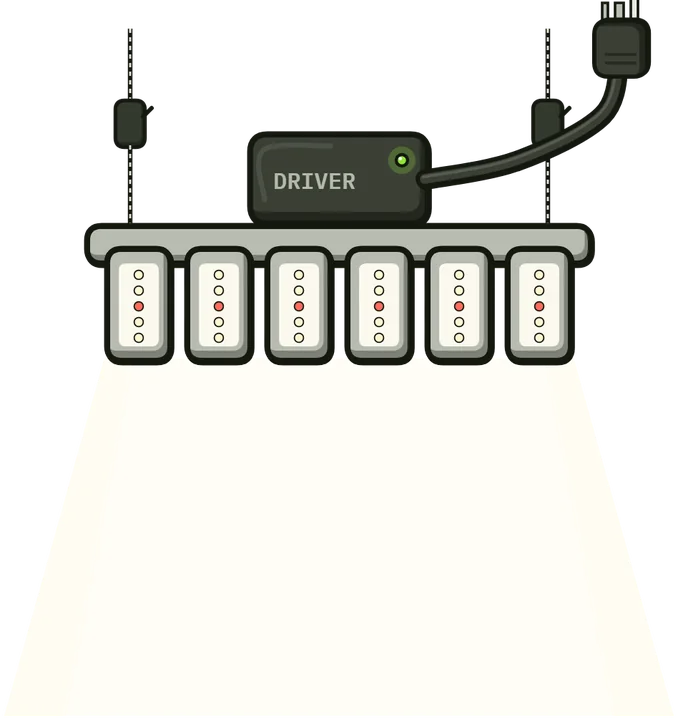
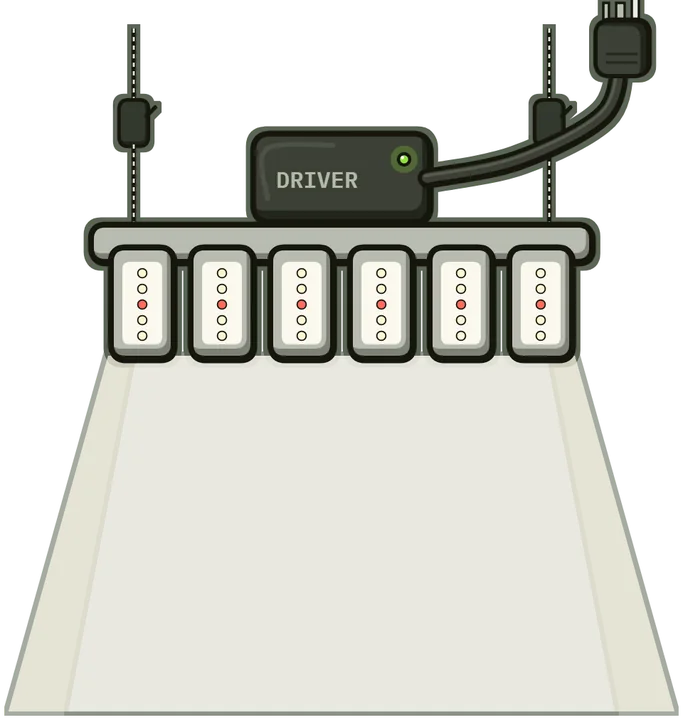
In the best indoor trial, cannabis flower yield rose linearly with canopy PPFD from 120 to 1,800 µmol/m²/s at ambient CO₂ (116 to 519 g/m²) with no change in cannabinoid potency. Practical targets: 100–300 µmol/m²/s for seedlings and clones, 300–700 (up to ~900) in veg, and 800–1,200 in flower, or more with CO₂, as long as the plant shows no stress and the electricity is worth it.
Supported
Draft: awaiting expert reviewUpdated
SeedlingVegFlowerAny system
Being reviewed. Our editors are double-checking a figure in this article against primary sources. Marked passages may change.
Short answer. Light is the single biggest yield lever indoors. In a 2021 trial with LEDs, a 12 h flowering photoperiod and ambient CO₂, dry flower yield rose linearly from 116 g/m² at 120 µmol/m²/s to 519 g/m² at 1,800 µmol/m²/s (about 4.5×) and did not saturate; cannabinoid potency did not change with light, terpenes rose modestly [1]. A 2022 trial on a high-THC cultivar found the same proportional yield response [2]. Practical targets: seedlings/clones 100–300, veg 300–700 (up to ~900), flower 800–1,200 µmol/m²/s, higher with CO₂ if the plants and your power bill tolerate it.
Hot topic: is 800 W in a 4 × 4 overkill? No. For a PR run it's underkill, by a mile: what the trial's straight-line yield response means in watts for every fixture tier, and the GenetixBay PR zone at 1,800–2,200 µmol/m²/s. Read 800 W in a 4 × 4 isn't overkill.
The 2021 light trialMore light, more grams, same potency
116 g/m²Dry flower at 120 µmol/m²/s
519 g/m²Dry flower at 1,800 µmol/m²/s
≈4.5×More yield, still rising (no saturation)
No changeCannabinoid potency per gram
Source: Rodriguez-Morrison, Llewellyn & Zheng 2021, LEDs, 12 h days, ambient CO₂ [1]; same proportional response in 2022 [2]
What's happening
Sol & the Zips The Sun and his photons. PPFD counts how many photons land on each square metre of canopy every second.
PPFD (photosynthetic photon flux density, µmol/m²/s) is the instantaneous photon rate hitting the canopy, 400–700 nm.
DLI (daily light integral, mol/m²/day) is the total for the day: DLI = PPFD × hours × 0.0036.
PPFD to DLIFrom the fixture to the day's total
The fixtureEfficacy in µmol/J sets the photons per watt [7]
PPFD at the canopyµmol/m²/sThe photon rate right now; measure it with a quantum sensor
× hours of lighte.g. 18 h in veg, 12 h in flower
DLImol/m²/dayPPFD × hours × 0.0036: the day's total
Individual leaves saturate well below the canopy's limit; whole-plant yield keeps climbing because lower leaves and bud sites receive more light as the top gets more [1]. Leaf light-response curves are a poor predictor of yield [1].
Higher light also shortens internodes, thickens leaves and makes denser, more compact plants in veg [3].
Numbers that matter
Stage
PPFD (µmol/m²/s)
Hours
DLI (mol/m²/day)
Evidence
Unrooted cuttings
50–150
18–24
3–10
Supported for horticultural cuttings: max ~100–150 at sticking [6]
Seedlings (cotyledons–2 nodes)
150–300
18
10–19
Grower practice; young-plant DLI 10–14 gives better roots in other crops [5]
Early veg
300–500
18–24
19–43
Grower practice; 24/0 house-endorsed (no sleep period needed in veg)
Late veg
500–900
18
32–58
Supported (preprint): healthy, compact growth up to ~900 [3]
Flower, ambient CO₂
800–1,200
12–13
35–56
Supported: yield linear to 1,800 [1][2]; 13/11 house-endorsed
Flower, 900–1,200 ppm CO₂
1,000–1,500
12
43–65
Supported (gas exchange) [4]; grower practice for yield
Conversions: 600 µmol at 18 h = 38.9 mol; 900 µmol at 12 h = 38.9 mol; 1,200 µmol at 12 h = 51.8 mol; 400 µmol at 24 h = 34.6 mol.
ChartPPFD targets by stageLight targets rise from 50–150 µmol/m²/s for unrooted cuttings to 800–1,200 in flower at ambient CO₂ and 1,000–1,500 with added CO₂. In the 2021 trial yield was still rising at 1,800.
Source: Stage table above: cuttings [6], seedlings [5], veg [3], flower [1][2], flower with CO₂ [4]; autoflowers are grower practice.
Show the numbers
Stage
PPFD target (µmol/m²/s)
Unrooted cuttings
50–150
Seedlings
150–300
Early veg
300–500
Late veg
500–900
Flower, ambient CO₂
800–1,200
Flower, 900–1,200 ppm CO₂
1,000–1,500
Autoflowers
600–1,000
ChartDLI targets by stageThe day's total light climbs from 3–10 mol/m²/day for unrooted cuttings to 35–56 in flower at ambient CO₂, 43–65 with CO₂, and 39–72 for autoflowers on 18–20 hour days.
ChartDLI = PPFD × hours × 0.0036The same PPFD gives a bigger daily total on a longer day. 600 µmol/m²/s for 18 h and 900 for 12 h both reach 38.9 mol/m²/day; 1,200 for 12 h reaches 51.8, inside the 35–56 flower band.
12 h of light
18 h of light
24 h of light
Source: The formula and worked conversions in this article; flower band from the stage table.
Show the numbers
PPFD (µmol/m²/s)
12 h of light: DLI (mol/m²/day)
18 h of light: DLI (mol/m²/day)
24 h of light: DLI (mol/m²/day)
0
0.0
0.0
0.0
1,150
99.4
1,500
64.8
97.2
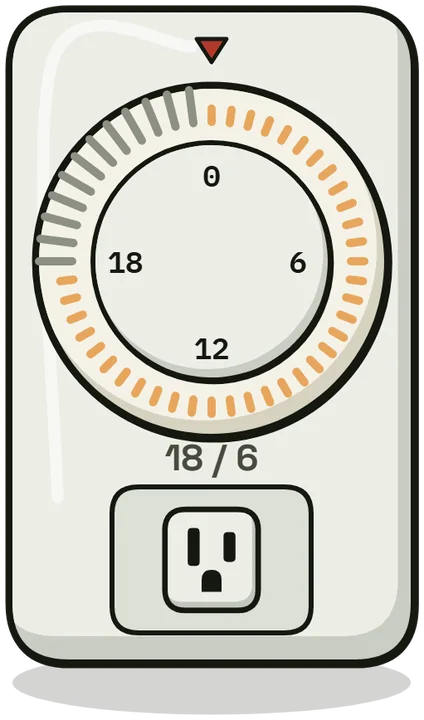
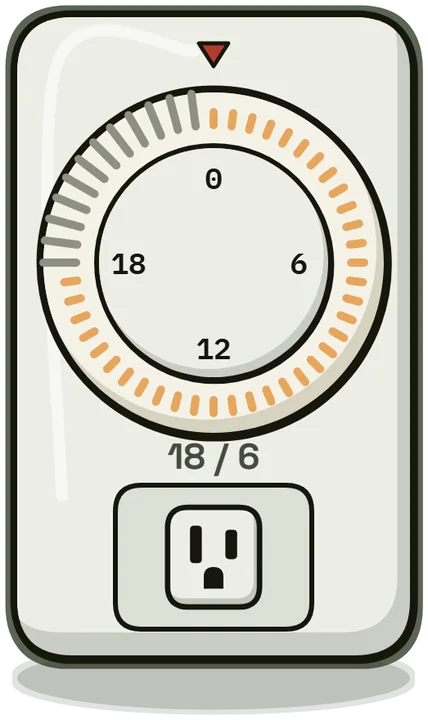
Photoperiod in practice. 24/0 is endorsed in veg; 13/11 is endorsed in flower, and some cultivars flower at 14–15 h (see photoperiod). In practice a GenetixBay flowering day is about 12 h at high intensity, with dimmed sunrise and sunset ramps adding the rest of a 13–15 h photoperiod. The ramps are low-intensity light, so they add little DLI, but they count as day: the uninterrupted dark that follows is what the plant measures. Count the ramps at their real PPFD when you work out DLI.
The economics
The same 2021 trial estimated ~0.54 g/kWh at 900 µmol/m²/s; doubling light raised yield about 70 % but cut energy-use efficacy about 15 % [1]. Fixture efficacy (µmol/J) matters more than any other lighting specification for cost per gram; current good LEDs exceed 2.5–3 µmol/J [7].
How to measure
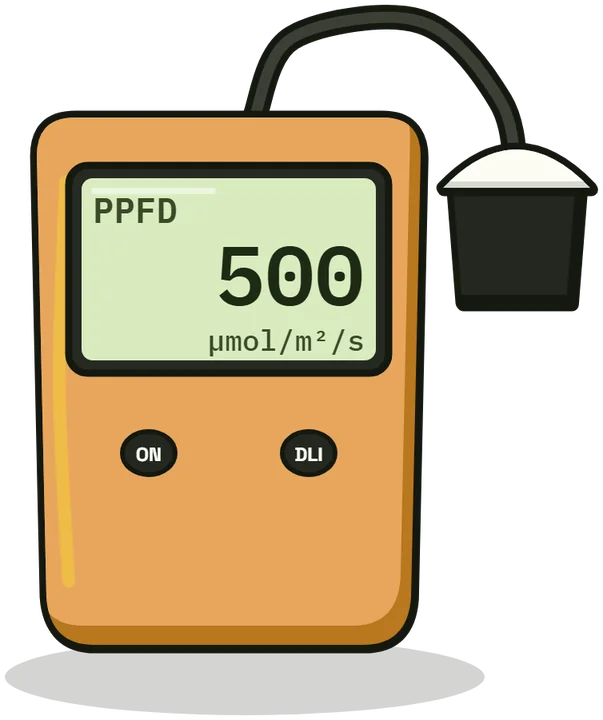
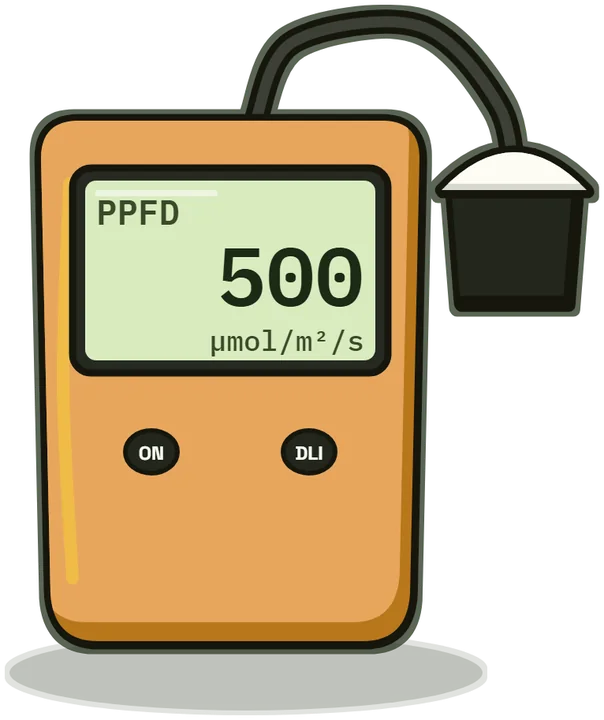
Use a quantum (PAR) sensor, not a lux meter. Lux-to-PPFD conversion depends on spectrum and is only rough.
Take a 9- or 16-point grid at canopy top height; record average and min/max. Aim for min ≥ 70–80 % of average.
Re-measure when plants grow; the canopy moves toward the light.
Phone apps are ±20 % or worse; fine for trends, not for setpoints.
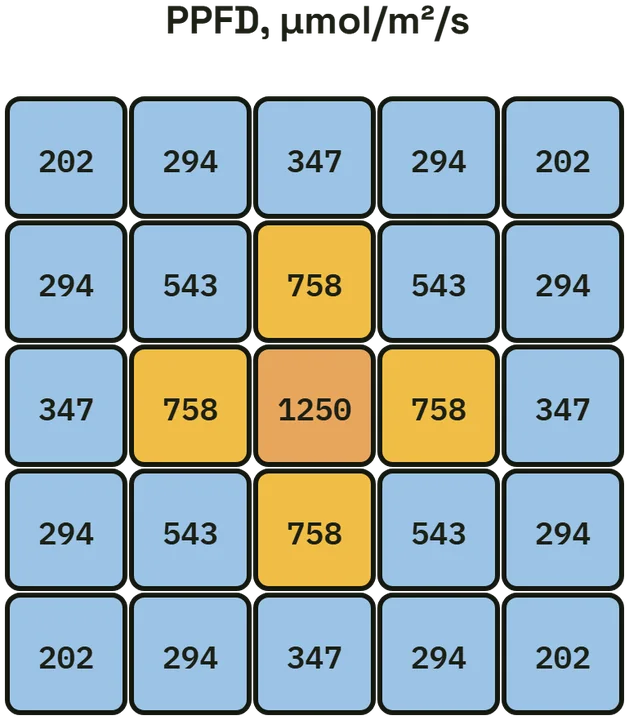
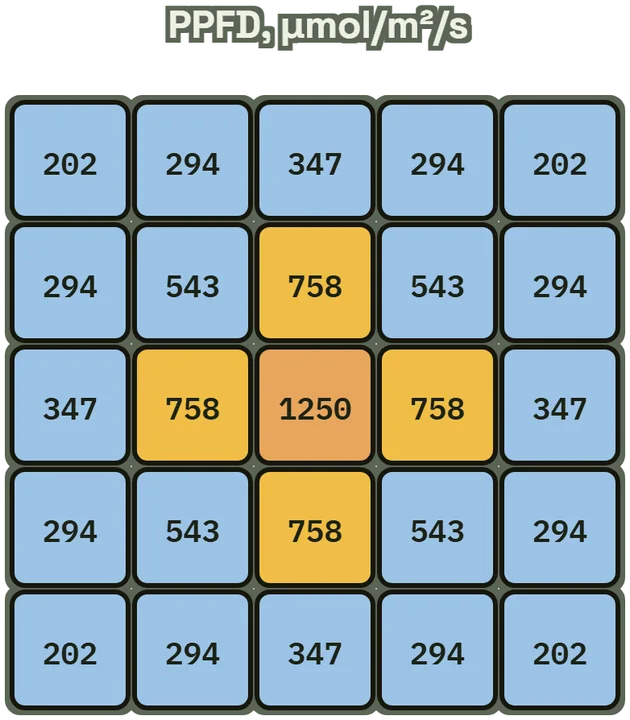
Why one reading lies: a grid map of a single light, brightest in the centre and far dimmer in the corners. Average the whole grid, and check the corners against it. Illustration: GenetixBay Academy library
How to raise light safely
Chloe The chloroplast that turns light into sugar. Push the light too fast and she can't keep up: leaves pray, bleach and taco.
Step up 10–15 % every 3–5 days in veg and early flower and watch the top leaves. Signs you've overshot: upward-praying leaves that stay that way at lights-on, bleached or yellow-white top bracts, tacoing, and pale new growth at the top only (heat and light stress).
Common mistakes
Using the manufacturer's centre-point PPFD at 30 cm as "my PPFD".
Hanging lights for the tallest cola and starving the rest.
Pushing above ~1,200 µmol/m²/s without CO₂ and good root-zone health, then blaming the strain.
Expecting more light to raise THC percentage. It raises grams; potency per gram stayed flat [1][2].
Evidence
Linear yield response to light in flower is Supported by two controlled indoor trials from one group [1][2]; it needs replication across more cultivars and with CO₂. No effect of light intensity on cannabinoid concentration is Supported[1][2]. Veg targets rely on a non-peer-reviewed preprint [3] and grower practice. Seedling/clone values are Grower practice plus general horticulture [5][6].
An LED (light-emitting diode) grow light uses solid-state diodes to produce light; modern fixtures are the most efficient grow lights, at roughly 2.5–3 µmol/J.The daily length of light versus dark; photoperiod cannabis flowers when nights grow long enough, rather than at a fixed age.Yield is the dry weight of usable flower harvested, usually expressed per plant, per square metre of canopy (g/m²) or per watt of light (g/W).Photosynthetic photon flux density: the number of PAR photons landing on one square metre each second, in µmol/m²/s; the standard measure of light intensity at the canopy.Potency testing is laboratory measurement of a sample's cannabinoid content, normally by HPLC, reported as % w/w or mg/g for each cannabinoid plus calculated totals.Terpenes are volatile hydrocarbon compounds built from five-carbon isoprene units; in cannabis they are made in the trichome heads and are a major part of aroma and flavour.A seedling is a young cannabis plant from emergence of the cotyledons until it has several sets of true leaves, typically the first 2-3 weeks.Daily light integral: the total number of PAR photons a square metre of canopy receives in one day, in mol/m²/day; PPFD multiplied by hours of light.Photon efficacy is how many micromoles of PAR photons a fixture produces per joule of electricity (µmol/J); higher means more light for the same power bill and heat.24/0 means lights on 24 hours a day with no dark period; GenetixBay endorses it for veg, as cannabis does not need a sleep period before flowering.13/11 is a flowering schedule of 13 hours light and 11 hours dark; GenetixBay endorses it, as most cultivars still flower while gaining extra daily light.A day-neutral cannabis plant that starts flowering by age, usually a few weeks after germination, regardless of light schedule; the trait is mainly recessive.Photosynthetically active radiation: light in the 400–700 nm waveband that plants use for photosynthesis, counted in photons rather than brightness.A leaf whose edges fold upward along the midrib like a taco shell or canoe, usually at the top of the canopy; a sign of heat, high VPD or excess light.THC (Δ9-tetrahydrocannabinol) is the neutral, decarboxylated cannabinoid mainly responsible for cannabis's reported intoxicating effects; the living plant makes it almost entirely as THCA.A cannabinoid is any compound that binds the body's cannabinoid receptors or shares the typical cannabis terpenophenolic structure; the plant-made ones are phytocannabinoids such as THCA and CBDA.
A practical PPFD for cannabis in flower at ambient CO₂ is 800–1,200 µmol/m²/s at canopy height, rising to 1,000–1,500 µmol/m²/s with 900–1,200 ppm CO₂. Research shows yield kept rising linearly up to 1,800 µmol/m²/s, so the ceiling depends on plant stress, root-zone health and whether the extra electricity pays. Measure with a quantum sensor grid, not the manufacturer's centre-point figure.
What DLI does cannabis need?
Cannabis DLI needs by stage are roughly 3–10 mol/m²/day for unrooted cuttings, 10–19 for seedlings, 19–43 in early veg, 32–58 in late veg and 35–56 in flower at ambient CO₂, or 43–65 with CO₂. Autoflowers on 18–20 hour days run about 39–72. Most of these figures are grower practice, while the flower response is supported by controlled trials.
Does more light increase THC?
No, more light does not increase THC percentage in cannabis. In two controlled indoor trials, raising canopy light from 120 to 1,800 µmol/m²/s multiplied dry flower yield about 4.5 times, from 116 to 519 g/m², while cannabinoid potency per gram stayed flat and terpenes rose only modestly. Extra light buys more grams, not stronger buds.
Is 1500 PPFD too much without CO2?
1,500 µmol/m²/s PPFD is not automatically too much for cannabis without added CO₂: one trial saw yield keep climbing to 1,800 at ambient CO₂. Still, practical targets at ambient CO₂ are 800–1,200, and pushing past about 1,200 without CO₂ and healthy roots often causes stress. Raise light 10–15 % every 3–5 days and back off at bleaching, tacoing or leaves that stay praying upward.
How do I convert PPFD to DLI?
To convert PPFD to DLI, multiply PPFD in µmol/m²/s by the hours of light and by 0.0036, giving mol/m²/day. For example, 600 µmol/m²/s for 18 hours equals 38.9 mol/m²/day, 900 for 12 hours is also 38.9, and 1,200 for 12 hours is 51.8. Use your measured canopy average, not a fixture's centre-point figure, and count dim ramps at their real PPFD.
What PPFD for seedlings and clones?
Cannabis seedlings do well at about 150–300 µmol/m²/s PPFD on 18-hour days, and unrooted clones at 50–150 µmol/m²/s on 18–24 hours. General horticulture research supports a maximum of roughly 100–150 µmol/m²/s for cuttings at sticking, and young-plant DLI of 10–14 mol/m²/day gives better roots in other crops; the cannabis figures are grower practice.
Sources
Rodriguez-Morrison V, Llewellyn D, Zheng Y, 2021. Cannabis yield, potency, and leaf photosynthesis respond differently to increasing light levels in an indoor environment. Frontiers in Plant Science 12:646020.doi.org/10.3389/fpls.2021.646020
Llewellyn D, Golem S, Foley E, Dinka S, Jones AMP, Zheng Y, 2022. Indoor grown cannabis yield increased proportionally with light intensity, but ultraviolet radiation did not affect yield or cannabinoid content. Frontiers in Plant Science 13:974018.doi.org/10.3389/fpls.2022.974018
Moher M, Llewellyn D, Jones M, Zheng Y, 2021. High light intensities can be used to grow healthy and robust cannabis plants during the vegetative stage of indoor production. Preprints 2021040417 (not peer reviewed).doi.org/10.20944/preprints202104.0417.v1
Chandra S, Lata H, Khan IA, ElSohly MA, 2008. Photosynthetic response of Cannabis sativa L. to variations in PPFD, temperature and CO2. Physiology and Molecular Biology of Plants 14(4):299–306.doi.org/10.1007/s12298-008-0027-x
Kusuma P, Pattison PM, Bugbee B, 2020. From physics to fixtures to food: current and potential LED efficacy. Horticulture Research 7:56.doi.org/10.1038/s41438-020-0283-7
The GenetixBay community is coming: honest grow journals, permanent GB-IDs for genetics, and a Professor who answers with citations. Founding Members get first access and a permanent badge.